
Build
Open a template and you are running. Or move the buildings, add the exposure across the street, and save it as a scene of your own — drag and drop: houses, apartments, strip malls, apparatus, hydrants, ladders, and nozzles.
Build the scene, build the incident, and extinguish the fire — together, in one room or spread across the county, on the computers your department already owns. There is no software to install.
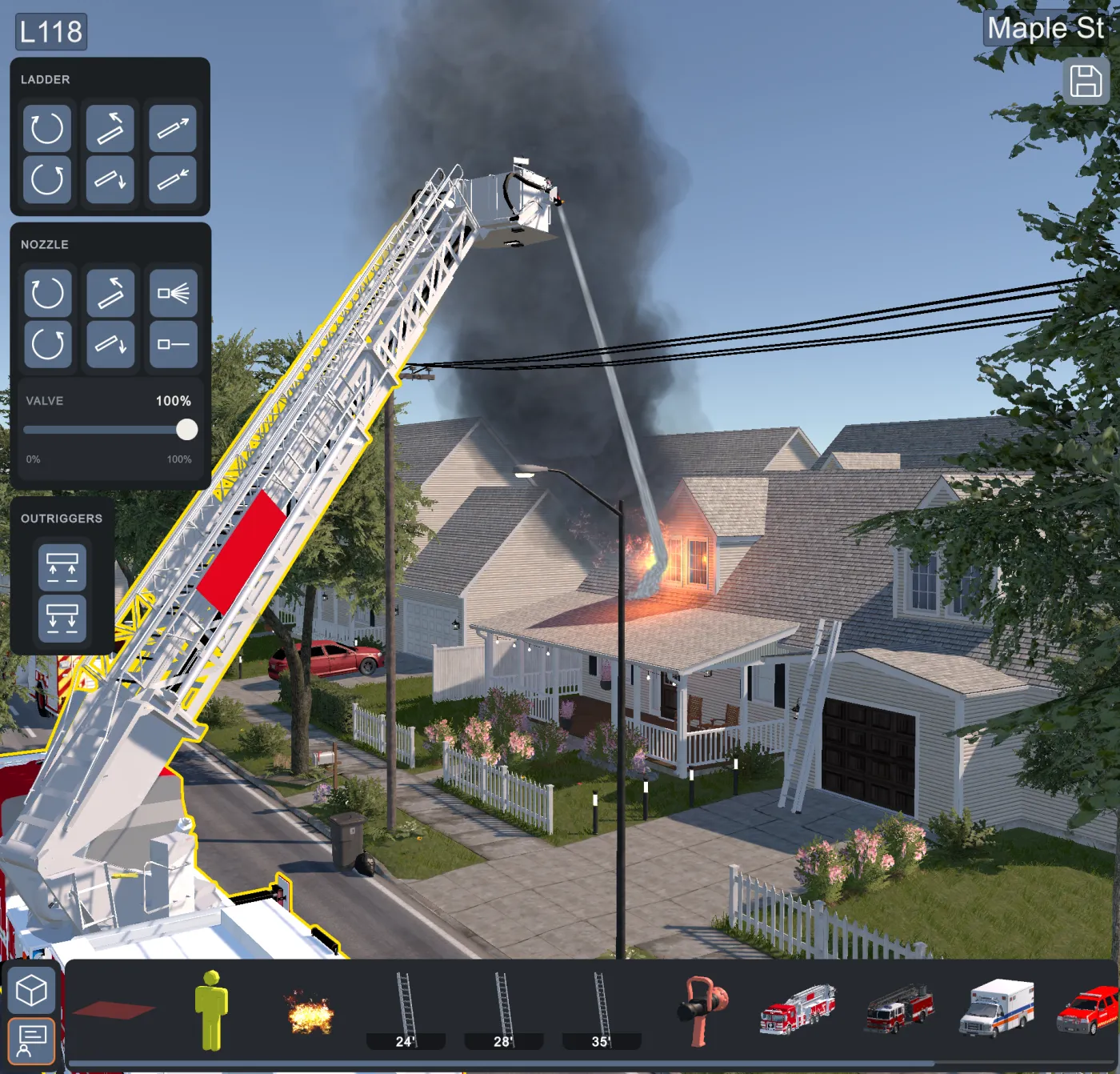
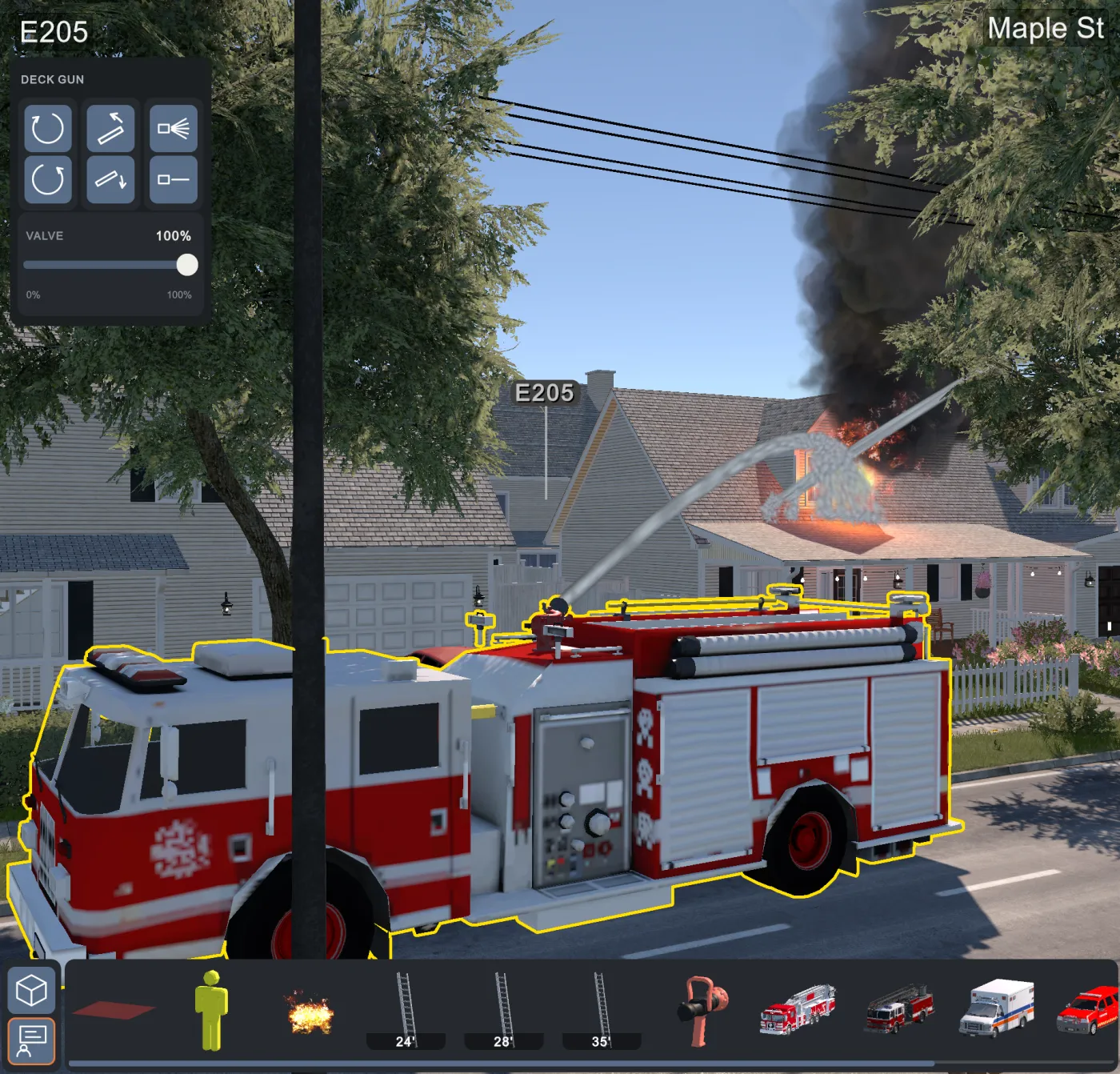
One product, three roles. The same person can author a scenario, run it, or take a position in it.
Open a template and you are running. Or move the buildings, add the exposure across the street, and save it as a scene of your own — drag and drop: houses, apartments, strip malls, apparatus, hydrants, ladders, and nozzles.

Two choices and you have a fire: what is burning — a structure, a vehicle, a flammable liquid — and how big. Drop it where you want it. No clock and no lesson script.

Hand out the join code and put a crew in the same scene at the same time. Water knocks the fire down, it comes back when the line comes off, and it goes out when a crew stays on it.
We build the templates, so you are not starting from nothing. A residential scene is ready to run today, with an apartment building and a strip mall following shortly. Open one, change whatever you want, and save it as your own.
An instructor starts a session and hands out the join code. Every participant is standing in the same scene at the same time, seeing the same fire from their own position. Move a ladder and the room sees the ladder move. Participants do not need an account.
And they do not have to be in the same building. The classroom at headquarters, a participant at their kitchen table, a mutual-aid company one town over — same drill, same fire, same conversation. Companies that would work together on a real call can train together without anyone getting in a vehicle.
Needs a working internet connection. There is no offline mode.
The first few minutes, over and over. What have I got, where do I put the rig, what do I do next — the decisions a company officer makes before anyone has done anything. They are the decisions you get the least practice at, and the ones that cost the most when they go wrong.
Apparatus placement is a real decision here. The rig sits where you parked it and the aerial works from where it is spotted. A crew sees what a poor position costs them, then resets and tries it the other way — a drill costs nothing but the time you spend on it.
The instructor drives the fire. You decide what is burning, how big it gets, and where it goes, and you change it the moment you want to — there is no script. The participants read what is in front of them and make the tactical calls. Water knocks it down; taking the line off brings it back. Built to teach smoke reading and size-up, not to give you exact numbers.
Every upgrade is included. It runs in a browser, so new features are simply there the next time you sign in — nothing to buy again, nothing to install, no upgrade to schedule. What you start with this year keeps getting better on its own.
And it is moving quickly. Being built right now: real-time radio communication between participants, and water supply — hydrants, hose, and connections. These are in progress — ask us and we will tell you exactly where they stand.
Coming, because departments need it. A record of who trained on what. It is not in the product today — we are telling you plainly rather than letting you find out — and it is on the list precisely because a training officer has to be able to show who was there.
Not in it today: search and rescue, since there are no victims in the scene; EMS, hazmat, and wildland, since we are initially focused on structure fire operations; and tablet or offline use — it runs on desktop and laptop browsers, with a connection.
You help choose the order. We are taking on a small number of departments to begin with, so the next thing we build is the one you keep asking for. Say what you need in the form below and it moves up the list.
Accurate as of 9 August 2026 — and this list keeps getting shorter.
It started as a situation board. Dan Mack spent his career as a fire officer and sold physical situation boards and props to departments before this. He is a partner in the business, not a consultant, and every tactical decision gets worked out with him before it is added to the product. The software is built by Ron Britvich, whose multi-user 3D platform from 1995 is still running today. Ron's father served 25 years with the Los Angeles Fire Department — the fire service is family for both of us. That history is why this is an instructor-driven size-up and tactics trainer, not a simple physics demonstration. And above all, NOT A GAME.
Tell us what you are trying to train and we will show you whether this does it. A person reads every one of these. We are onboarding a handful of departments this fall, so tell us what you need and we will tell you honestly whether we are the right fit.